





Leadership is not what people hear in a meeting. It is what they watch when nobody is trying to make a point.
A team leader, supervisor, manager, director, ceo, md or business owner can tell people that training matters, reporting matters, competence matters and compliance matters, but if their own actions say something different, the team will believe the actions.
People notice when managers skip the process. They notice when training is handed out without explanation. They notice when reporting is treated like an inconvenience. They notice when someone is given a task because they are nearby, not because they are ready. They also notice when leaders chase everyone else for records, forms, actions and updates while their own responsibilities sit ignored in the background.

Leading by example is not about being perfect. Nobody is perfect, and people do not expect their leaders to have every answer. What they do expect is consistency. They need to see that the same standards apply to everyone, including the people in charge. That is how leaders turn safety, compliance, wellbeing, cyber awareness, workplace behaviour and training from boring admin into everyday expectations.
For employees, this matters too. If you are part of a team, you are not just watching leadership, you are learning what is acceptable. You can also help shape the culture by asking questions, reporting concerns, checking your own responsibilities and speaking up when something is unclear. Stronger workplaces are not built by one heroic leader standing. They are built through everyday behaviour, repeated until it becomes normal.
A lot of organisations talk about leadership like it belongs in a glossy brochure. Values, culture, accountability, standards and integrity are all useful words, but words alone do not change how people behave at 4:45pm on a Friday when a form needs completing, a course is overdue, a permit needs checking or someone says, “Can we just get this done quickly?”
That is where leadership shows up. Not in the big speech, but in the small decision. Do you check the record or trust memory? Do you ask whether someone is competent or assume they are fine because they have been around for years? Do you make reporting easier or make people feel awkward for raising issues? Do you keep your own training and responsibilities current, or act like compliance is only for everyone else?
This is where team leaders, supervisors, managers and senior leaders set the temperature. If the person in charge treats systems, training, reporting and procedures as optional, the team will copy that behaviour. Maybe not immediately, but slowly and quietly.
When something goes wrong, organisations often ask why the culture failed. The truth is that culture usually does not fail in one dramatic moment. It fails because the wrong example has been set over and over again until people decide that the official process is not really the way things are done.
Leaders do not need to complete every course before assigning training to someone else. That would be unrealistic in most organisations. But they do need to understand enough to make a sensible decision. Before asking someone to complete training, a leader should know what the training covers, who it is aimed at, what problem it is designed to solve and what the person should be able to do differently afterwards.
Training is not just content. It is a tool for changing knowledge, confidence and behaviour. A good course should help someone do their job better. It should help them understand a risk, follow a process, use a system, report a concern, manage a responsibility or make better decisions in real situations. If a manager assigns training without knowing what it is for, they are not leading. They are throwing content at a problem and hoping something sticks.
That approach creates weak results because different people need different learning for different reasons. A new starter may need basic awareness. An experienced worker may need a refresher. A supervisor may need more detailed responsibility-based training. Someone moving into a new role may need support before they can be expected to perform confidently. Training should match the person, the role and the risk, not just fill a gap on a spreadsheet.
Leaders should ask themselves whether the course is the right level, whether it solves the right problem and whether the person will need any follow-up afterwards. Some training may be enough on its own. Other training may need a conversation, observation, coaching or practical support before the person is truly ready. This does not mean turning every training decision into a committee meeting. It means caring enough to match training to the need.
For employees, the lesson is simple too. If you are asked to complete training and you do not understand why, ask. If the course does not feel relevant, say so constructively. If you complete it but still do not feel confident, that matters. Training should not just tick a box. It should leave you better equipped to do the job safely, clearly and confidently.
Reporting should not feel like waiting to be judged. Yet in too many workplaces, people hesitate before reporting something. Not because they do not care, but because they are worried about what happens next. They may wonder whether they will be blamed, whether they will be seen as difficult, whether their manager will roll their eyes, or whether raising the issue will create more hassle than staying quiet.

That is how problems stay hidden. Leaders need to show that reporting is not a failure. It is part of how a responsible workplace works. This includes reporting hazards, near misses, incidents, equipment issues, poor processes, cyber concerns, training gaps and anything else that could affect safety, quality, wellbeing or compliance.
It also means creating enough openness that people feel able to say, “I’m struggling with this,” “I don’t feel confident doing that,” “I need more training,” or “I’m not sure I understand the process.” Those statements are not signs of weakness. They are signs that someone is paying attention before a small issue becomes a bigger one.
A good leader makes reporting calm, normal and practical. The leader’s response matters because people remember it. If someone reports an issue and the first reaction is irritation, the team learns to stay quiet. If the first reaction is curiosity, support and action, the team learns to speak up earlier. That does not mean every report will be serious. Some will be minor. Some may be based on misunderstanding. Some may need investigation. But every report gives the organisation information it did not have before.
For employees, reporting is part of keeping yourself and others safe. If something does not feel right, it is better to raise it early than wait until it becomes a bigger problem. Nobody wants to be the person who says, “I noticed that last week,” after something has already gone wrong. A healthy workplace does not depend on people being brave every time they speak up. It builds reporting into the rhythm of work so people do not need to be brave. They just need to be honest.
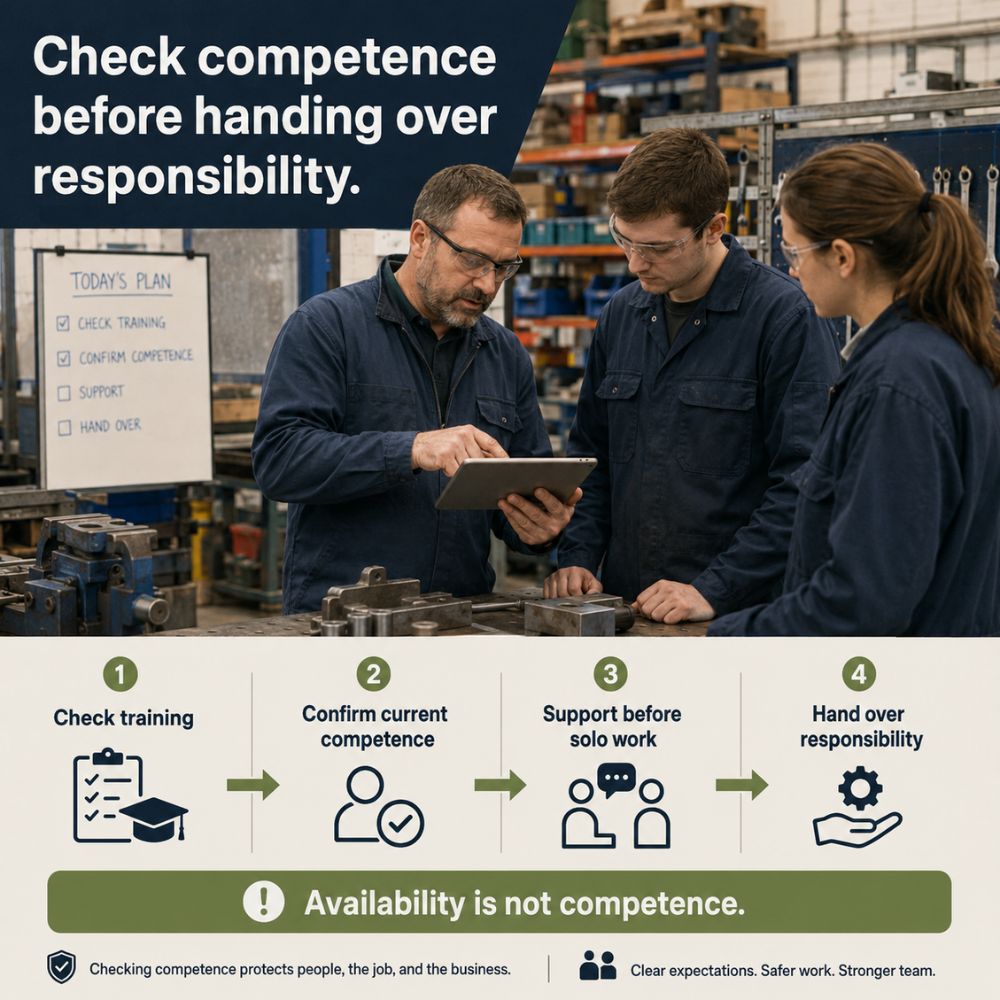
Availability is not competence. Just because someone is free, nearby, experienced-looking or “usually alright with that” does not mean they are the right person for the task. Before handing over a responsibility, task, permit, system access, piece of equipment, process or decision, leaders need to check whether the person is actually competent to do it.
This means looking beyond confidence. Some people sound confident and are not ready. Some people are competent but need a refresher. Some people completed training years ago but have not used the skill since. Some people know the theory but need support applying it in the real world. Competence is not a vibe. It needs checking.
This is especially important in workplaces where mistakes can affect safety, compliance, data, equipment, customers, contractors, vulnerable people or the wider team. A leader should understand whether the person has had the right training, whether that training is still current, whether it was the correct version or level, whether they understand the process and whether they need supervision before being left alone.
This is not about slowing everything down. It is about stopping the classic business horror scene where someone says, “I thought they knew how to do it.” That sentence should make every responsible leader uncomfortable, because “I thought” is often what people say when nobody checked.
Leaders set the standard by asking the sensible question before the work begins, not afterwards, not when something has gone wrong and not when the incident report is already being written. Checking competence protects the person doing the work, the people around them and the organisation as a whole. It also makes expectations clearer because people know what they are authorised, trained and ready to do.
For employees, this is also a useful reminder. Being asked to do something does not automatically mean you are ready or authorised to do it. If you are unsure, say so. If you need a refresher, ask. If you think a task is outside your training or confidence, raise it before you start. A strong workplace does not punish people for saying, “I need help.” It respects them for knowing the line between confidence and competence.
Leaders cannot ask people to care about compliance while their own responsibilities are a mess. That is the uncomfortable bit. If a manager expects people to complete training, read policies, follow procedures, submit forms, report issues and keep records current, they need to show the same discipline themselves. Otherwise, the message becomes clear: compliance is important for you, but flexible for me.

That destroys trust. Leading by example means keeping personal responsibilities visible and current. It means completing required training, reading and acknowledging key documents, responding to actions, reviewing reports, closing loops and checking that important tasks have not disappeared into the fog.
This is where leadership becomes practical. It is not a speech, a values poster or a LinkedIn quote floating over a mountain while someone pretends “synergy” means anything. It is doing the boring, necessary stuff properly because everyone else is watching. The boring stuff matters because it keeps the organisation honest. It creates evidence. It protects people. It shows what has been done, what still needs doing and who is responsible for the next action.
Leaders who keep their own records and responsibilities up to date send a clear message to the team. They show that the process matters because they treat it like it matters. They do not make compliance feel like something dumped onto employees while managers float above it. They make it part of how work is done.
For employees, this is a useful standard to follow as well. Keep your own training, documents, forms and responsibilities current. Do not wait until someone chases you. If you know something is due, act. If you cannot complete it, explain why. If something looks wrong in your record, raise it. Good teams work better when responsibility is visible, not hidden in someone’s inbox, spreadsheet or memory.
Guesswork is not leadership. It might feel quicker. It might feel easier. It might even work most of the time. But when safety, confidence, compliance, wellbeing or responsibility is involved, guessing is just rolling dice and calling it experience.
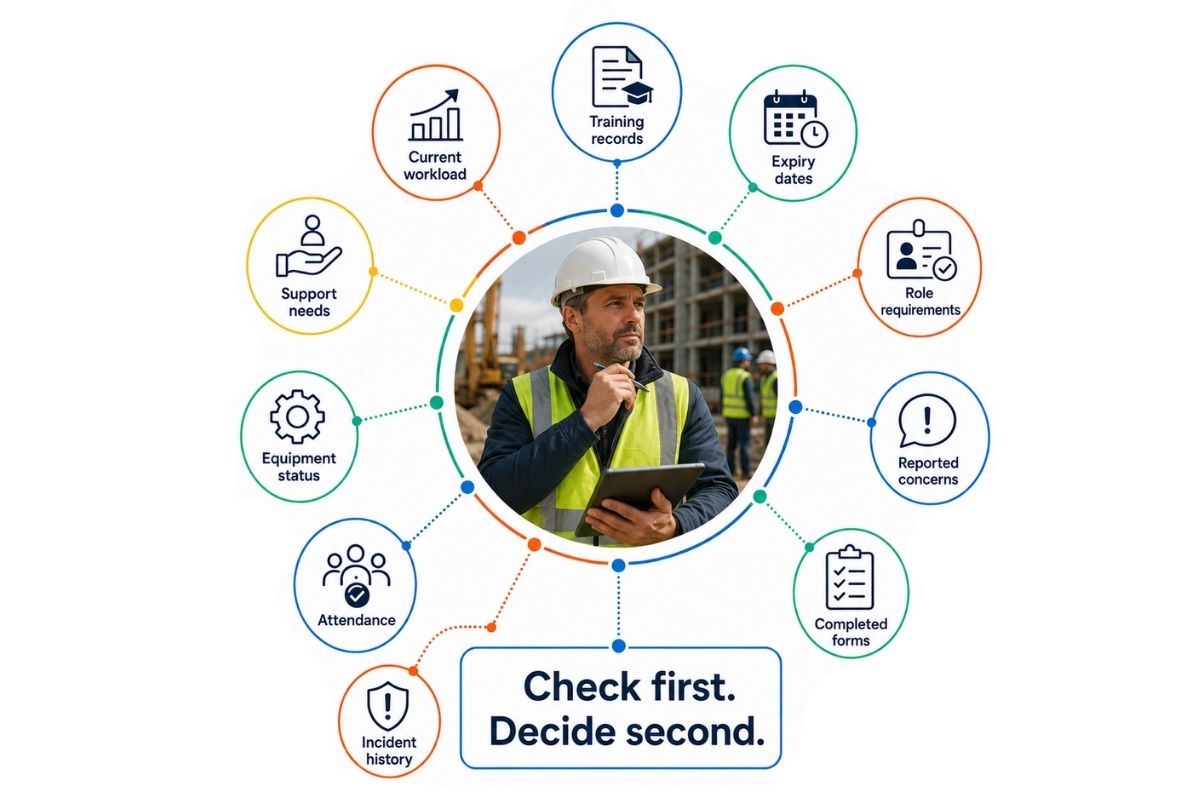
Good leaders use the information available before making decisions. Before assigning work, they check whether the person is trained and ready. Before approving access, they check whether the person has the correct permission and requirements. Before choosing training, they check what the person needs and what gaps exist. Before responding to an incident, they look at the facts. Before deciding whether someone is ready for a task, they check records, context and confidence.
This is where leadership gets sharper. Useful information might include training records, expiry dates, role requirements, reported concerns, completed forms, incident history, attendance, equipment status, support needs, previous actions and current workload. Used properly, that information helps leaders stop making decisions based on memory, habit or who happens to be standing closest.
Because “Dave’s usually alright with that” is not a control measure. A leader who checks first and acts second creates better outcomes. They reduce avoidable mistakes. They spot gaps sooner. They support people before they struggle. They avoid handing responsibility to someone who is not ready. They make decisions that can be explained, not just defended afterwards.
This also helps employees. If decisions are based on clear information, people are less likely to feel singled out, ignored or unfairly treated. It becomes easier to understand why training is needed, why access is restricted, why a refresher has been assigned or why a task needs someone with a specific competence.
Information does not replace judgement. It improves it. The best leaders still listen, observe and talk to people, but they do not rely on gut feeling alone. Gut feeling has its place. So does checking the actual record before someone gets handed responsibility for something important.
People copy what gets tolerated. If leaders tolerate sloppy training decisions, reporting becomes weak. If leaders tolerate silence, problems stay hidden. If leaders tolerate assumptions, competence becomes guesswork. If leaders tolerate overdue responsibilities, compliance becomes theatre. If leaders tolerate decisions made without evidence, the organisation becomes dependent on memory, confidence and luck.

That is not a safe way to run a team. Leading by example means making the expected behaviour visible. It means showing people how responsible work is done. It means treating training, reporting, competence, records and decision-making as part of everyday leadership, not as admin dumped on the side of the job.
For team leaders and supervisors, this is about the daily habits that shape how people behave on the ground. For managers and directors, it is about creating the conditions where people can do the right thing without fighting the system. For ceos, mds and business owners, it is about making sure the organisation does not say one thing in policy and do another thing in practice.
And for employees, it is a reminder that good culture is not something you wait for someone else to create. You contribute to it every time you ask, report, check, learn, support and speak up.
Give your team the confidence to train properly, report early, check competence and make better decisions before problems grow.